

For reasons I cannot fully explain, I’ve always had an implausible infatuation with terrible cars. I’m like the Statue of Liberty, only for shitty automobiles.
“Give me your rusty
Your terrible and unloved
Your downright useless and badly made
And I will give them tender love and care”
I’m sure that’s not how the poem goes, but you get the gist. Look, the point is that as far as I can remember, I’ve always loved abandoned, rusty, or otherwise decrepit cars. I can vividly recall approaching old Dacias and Oltcits in my native city of Craiova, Romania with a sense of pity and intrigue. These machines were once the pride and joy of their owners; they were shiny beacons of accomplishment fresh off the showroom floor. Now here they lay, forlorn and forgotten, nestled between Communist-era apartment towers or streetside parking lots. These cars likely ignited my lifelong automotive passion so in a way, I feel I owe them my thanks.

Those of you who know me in real life or those who have read some of my old articles might know that I worked at a car museum until recently. While the job itself was alright, it allowed me to experience and appreciate a vast array of cars that came through the Museum’s doors. Even though my eyes were opened to newfound clubs or segments of the automotive space that I was previously unaware of, my heart still belonged to the kind of automobiles that my friend Alan’s Concours d’Lemons attracts. It wouldn’t be too long, however, before that void was filled.
The way the museum was arranged included the inside of the building, with the various displays and car sales area, as well as an outside area dubbed “The Side Yard.” This yard would often become the home of cars that were deemed not worthy enough for a spot inside, away from the elements and the colony of stray cats that the outside housed. Since I started working there in 2021, there was one particular car that lay dormant, seemingly never to see a blacktop again: a 1975 Datsun 620 pickup truck.

This particular 620 had seen better days, to put it extremely mildly. The orange paint had been covered in a dull, gray primer, while the interior had served as a nest and unfortunate toilet for enough rats to clog a small town’s sewer system. Think of the most appetizing smell you can imagine, and then think of the complete opposite. That’s what this truck smelled like. It would put abandoned truck stop bathrooms to shame. To really put a cherry on top of the shit sundae, someone had put a nice, now-rusted, gash on the side of the bed that looked like a forklift accident or an unfortunate encounter with Wolverine. The story went that the museum received it as a donation around 2018 with a few other 620s like it. Its brethren were sold and moved on to new homes, while this one sat hoping for a similar fate.
For the first year of my employment, the 620 served as nothing more than a laughing stock between employees, an example of what we considered to be the automotive epitome of rock bottom. That is until sometime in November of 2022.

It was a sunny, lazy day, without many visitors or really anything important to do. One of my friends and museum docents, Mike Ball, came in for his shift and we proceeded to talk about whatever had been going on that day. In a largely joking manner, I suggested that one of these days, I’d stick a battery in the Datsun just to see what would happen.
“Well let’s go then! Let’s do it right now,” Mike returned.

Taken aback by this, but never one to back down from doing something most sane people would consider incredibly stupid, I agreed. After robbing a battery from another car and sourcing the Datsun’s keys, we sauntered off to the side yard for what I believed would be a fruitless endeavor.
Under the hood was a very intact L20B four-cylinder engine, without too much rust yet with plenty of cat hair and rat dookie. With a fresh battery installed, the truck did not react in the slightest. No lights, sounds, and thankfully no fires either. I put the 4-speed manual transmission in neutral, held the clutch down, turned the key, and was pleasantly surprised by an engine that turned over and sounded relatively healthy given the state of the truck.

It’s at this point I should mention that I had no previous experience of working on cars. I was, and mostly still am, enticed by the design rather than the powertrain of my favorite cars. However, I saw the Datsun as an opportunity to learn more about automotive maintenance; maybe I would even get it roadworthy again. And even if I did somehow wreck it further, it would not only be a learning experience but nobody would care given that it was essentially abandoned by the museum.
My first lesson was never to throw parts at your project vehicle. Rather than look up precisely what essential components needed checking (spark, fuel, etc.) I instead opted to replace anything that looked even remotely janky. In hindsight, those parts were very likely completely functional but replacing them taught me their individual roles. I learned how to rebuild a carburetor and how even a pinhole-sized vacuum leak can have utterly detrimental effects on the way your engine runs or hell, if it runs at all. At least the original fuel tank was usable after a thorough cleaning!
Wiring was an entirely different can of worms too. After finding a long desiccated rat carcass under the dashboard, I quickly decided to distance myself as much as possible from the factory wiring and attempt to rewire whatever didn’t function. Through the use of YouTube, an Amazon power distribution block, and a race car switch panel, I was able to rewire the low beams and the high beams to two separate toggle switches, successfully marking my foray into being an amateur electrician. I look forward to finding out which one of the scrap wires I used becomes the first fire hazard.
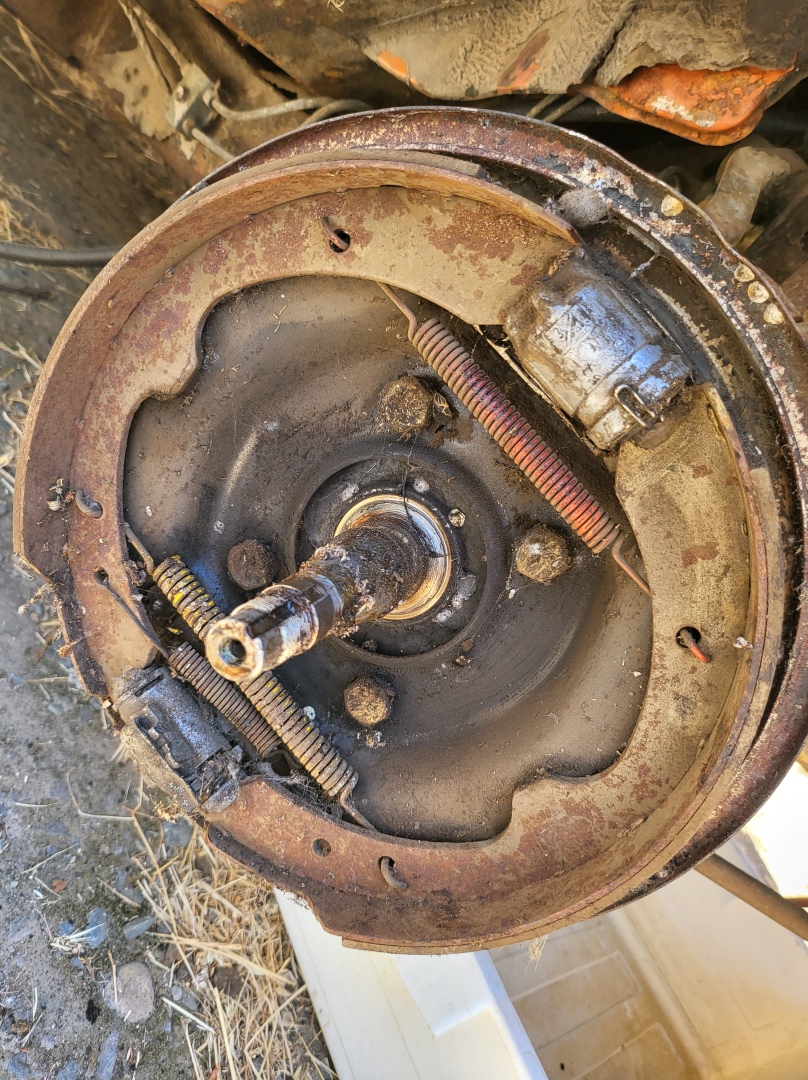
The most fun I had during this process though, and I am being as sarcastic as one can be through text, came around when it was time to tackle the brakes. Not only does the 620 use drum brakes all around, but given that this one sat for an unknown number of years, the shoes were all rusted to the drums. What ensued was a dayslong battle between the brakes and numerous tools of various sizes and levels of violence. I was eventually victorious by way of pushing a bolt through two pre-existing holes in the face of each drum. And yes, I did have to change the master cylinder AND run new brake lines to each wheel.

With a running engine, somewhat cooperative brakes, and a transmission that thanked me profusely for its new master and slave cylinder, the Datsun now resembled a real car; at least mechanically. Words can’t properly describe the feeling of that first drive. It had moved under its own power around the yard before this but pulling it out onto the concrete was like freeing a caged bird. With each subsequent drive, the little 620 showed me its willingness to get back on the road after such a long hibernation, and I was more than happy to fulfill its wishes. I helped continue this truck’s story, after whatever circumstances led to it being abandoned in the museum’s Side Yard, and gave it a chance to live again.
I am currently in the process of obtaining a title for it, meaning that thanks to California’s lack of inspections and the truck being smog-exempt, it will soon be registered for legal road use. Will it be safe? Questionable. Will it be a hit at car shows? You’re damn right it will. I hope to show anyone who sees it that every car, regardless of its make, model, or condition, deserves another chance at “life”. Some people adopt animals from shelters, and that’s cute and all. Me? I save rusty Japanese pickup trucks from the yards of museums.


 AutoSaga
Leave a comment